
How You Clean Matters: What New Research Means for Listeria Control in Food Plants
October 2, 2026
An Uneven Comparison
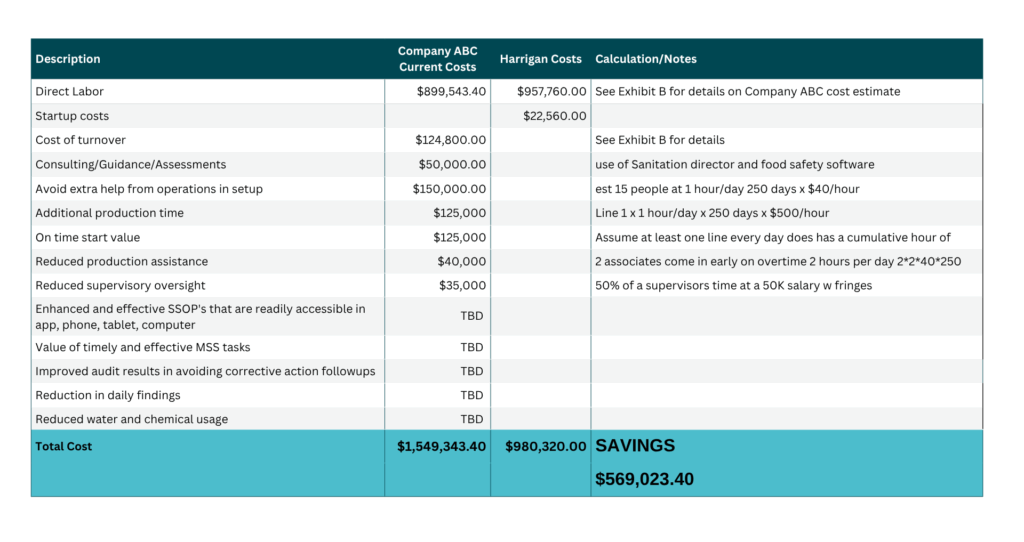
Most food and beverage manufacturers spend far more on sanitation than they think. They just never see it as a dedicated line item. Labor sits inside production payroll, staff turnover hides in HR, and delays show up as late startups that nobody identifies as a sanitation cost.
When we compile and build the business case for a dedicated sanitation team, the comparison operations leaders make in their heads can feel uneven: a clear, all-in number on one side, and a set of scattered costs on the other. Here, we walk through what sanitation really costs, what it quietly takes away, and why seeing it all in one place matters.
What You’re Already Spending
An in-house sanitation program carries a real price tag, spread across many departments:
- Direct labor. Wages and fringe benefits for the sanitation supervisor and crew, usually folded into production payroll.
- Overtime. Extra hours to cover PTO, call-offs, and open positions, also under payroll.
- Turnover. Recruiting, onboarding, training, trainer time, and overtime. These costs tend to land in HR and plant overhead.
- Consulting, guidance, and assessments. Outside experts brought in for audits, gap assessments, or recurring problems.
- Janitorial services. Separate contractors for welfare areas, offices, and general housekeeping, often billed through facilities.
Why is staff turnover so important? Sanitation is hard, physical, overnight work, and turnover in these roles runs high. Plants often replace their entire sanitation crew in a single year. Every departure restarts the cycle: hire, train, cover the shift, and hope the new person stays.
Add these lines together and the in-house number is often larger than leaders expect. That’s before counting the opportunity cost–what sanitation costs you on the revenue side.
What You’re Not Seeing: The Opportunity Cost
Often, the biggest cost of sanitation is the production an unreliable program keeps you from running.
- An extra day on the line. When sanitation runs long or unpredictably, production can’t count on that time.
- On-time MSS tasks. Tasks that slip become audit findings and unplanned downtime.
- Clean warehouses. Housekeeping falls to the bottom of the list when the crew is stretched.
- Management time. Hours spent covering shifts and chasing pre-op failures are hours not spent running the business.
- Room to grow. Leaders who aren’t firefighting sanitation can focus on new products and new volume.
None of these show up on an invoice, which is exactly why they’re easy to overlook. In our experience, they’re often worth more than the direct costs combined.
Reduced Costs and Added Capacity
In a recent assessment, we added up what sanitation was really costing one plant: labor, turnover, outside consulting, and the time operations staff spent helping with setup. A dedicated Harrigan team came in well below that total. Once we counted recovered production time and on-time starts, the plant stood to gain more than $500,000 a year. For another plant, the savings and recovered capacity were worth seven figures a year.
What a Dedicated Team Brings: Quality, Consistency, and Clarity
A trustworthy, dedicated team takes the cost you already carry, makes it visible, and turns it into capacity. You get one all-in number that shows what sanitation really costs, plus results that build on each other:
- Quality sanitation: food safety and clean pre-op inspections.
- Reliable startup: production starts on time, with less variation.
- Extra capacity: shorter cycles return hours to the schedule.
- Profitable volume: recovered hours create more cases shipped.
A dedicated team, led by a Crew Chief who knows your plant, brings the accountability and continuous improvement that keep your sanitation program healthy.
Start the Conversation Today
Every plant is different, and a dedicated team makes more sense for some than for others. A short conversation is the best way to find out. We’ll talk through how sanitation works at your plant today, what it’s costing you, and where you’d like more capacity. Then we’ll decide together whether a dedicated Harrigan team is a good fit.
Interested in learning more? Email President Dave Stern at dstern@harrigansolutions.com, or submit a contact form here.